
Precision Visibility for Stable Semiconductor Manufacturing
How thermal and acoustic imaging can help semiconductor manufacturers improve condition awareness, protect process stability, reduce operational risk, and make faster decisions across the fab.
www.flir.com
Semiconductor manufacturing is one of the most demanding industrial environments in the world. A modern fab brings together a vast range of systems: tightly controlled production processes, highly sensitive equipment, vacuum and gas delivery systems, electrical and mechanical infrastructure, cooling and utility systems, and cleanroom conditions—all of which must perform with exceptional consistency. Small variations in temperature, pressure, equipment condition, or utility performance can become significant when production tolerances are narrow and the cost of disruption is high.
The challenge is not simply keeping individual machines running. Semiconductor manufacturers must maintain stable processes to maximize manufacturing efficiency across a highly connected operating environment. A developing issue in a pump, electrical cabinet, vacuum line, process tool, cooling system, or facility utility may begin as a small anomaly but can create wider operational impact if it is not identified early. At the same time, many of these conditions are difficult to see through conventional visual inspection alone.
This makes visibility an important part of modern semiconductor operations. Teams across the manufacturing process need practical ways to understand what is happening to equipment and infrastructure without unnecessarily interrupting production. The earlier an abnormal condition can be identified, the more time teams have to investigate the cause, prioritize the response, and take corrective action before the issue develops into a costly issue such as downtime, process instability, or quality loss.
Thermal imaging is valuable in this environment because it converts temperature differences into a visual image that can be interpreted quickly. Instead of relying only on a single point measurement, users can compare temperature patterns across assets and process areas. This broader view can reveal abnormal heating, uneven temperature distribution, thermal drift, overloaded electrical components, mechanical friction, insulation issues, or other conditions that deserve further investigation.
For semiconductor process and product-related work, thermal imaging can also provide insight into temperature distribution and thermal uniformity. These measurements can help process, quality, R&D, and engineering teams better understand thermal behavior, identify unusual patterns, and support analysis where temperature is an important process or product parameter. The value is not simply the image itself, but the ability to turn temperature information into evidence that supports faster and more informed decisions.
Acoustic imaging adds a different but complementary layer of inspection. Vacuum, compressed air, and gas systems are common across semiconductor manufacturing and supporting facilities, and leaks can be difficult to locate in noisy industrial environments. Acoustic imaging can help users visualize the source of certain leaks from a distance, supporting faster localization and more targeted inspection. This can reduce the time spent searching for problems and help teams focus maintenance activity where it is most needed.
The non-contact nature of thermal and acoustic imaging is also important. Semiconductor facilities contain energized electrical systems, moving equipment, hot surfaces, inaccessible components, and sensitive processes. Being able to inspect from a practical distance can help teams gather useful information while reducing the need for unnecessary physical contact or process interruption. This supports safer inspection practices and can improve the efficiency of routine maintenance and troubleshooting workflows.
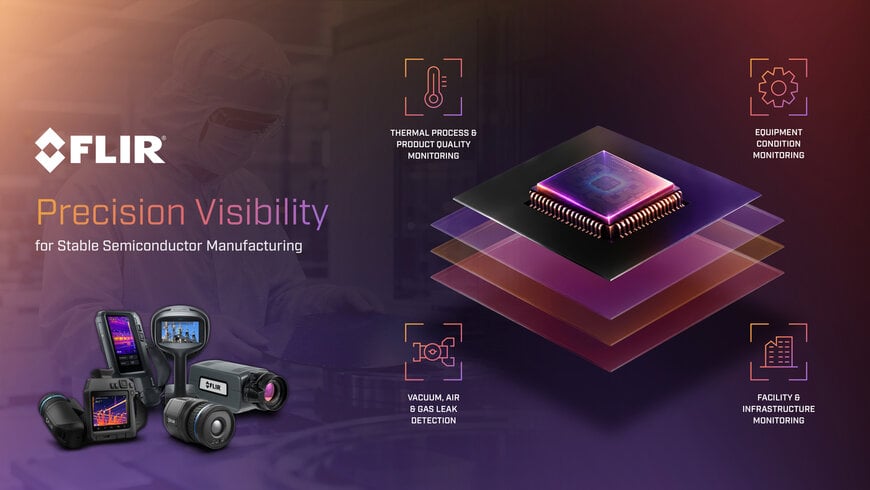
The value extends across the fab. Vacuum, compressed air, and gas leak detection can support process stability, equipment performance, and efficiency. Thermal process and product quality monitoring can provide visibility into temperature behavior and uniformity. Equipment condition monitoring can reveal abnormal thermal or acoustic signatures before they become obvious failures. Facility and infrastructure monitoring can help teams inspect electrical distribution, HVAC, cooling systems, pumps, motors, and other utilities that are essential to reliable semiconductor production.
Different applications require different levels of inspection and monitoring. Handheld thermal and acoustic systems give technicians the flexibility to perform routine inspections, troubleshoot specific problems, and investigate assets when needed. Fixed thermal and acoustic imaging can provide continuous monitoring capabilities for critical equipment or processes where conditions need to be observed over time. Advanced infrared cameras can support detailed measurement and analysis for specialized process, product quality, science, and R&D applications. This gives manufacturers the ability to select the right level of condition awareness for the task rather than relying on one approach for every application.
Flir supports these different needs through a broad portfolio of thermal, acoustic, and software solutions. For routine inspection and troubleshooting, handheld products such as the iXX-Series, Exx-Series, and T-Series thermal cameras along with the Si2-Series acoustic imagers can help teams inspect critical assets, detect anomalies, identify leaks, and document findings across fab equipment and facility systems. Software platforms such as Assetlink and Thermal Studio can further support inspection workflows, analysis, and reporting.
For fixed-mount continuous monitoring and advanced thermal applications, the AX8, A50/A70 Smart Sensor, and Axxx-Series Smart Sensor offer on-camera analytics and alarm capabilities, while R&D/Science products such as A-Series Science Kits, A6780, and A8580 support research and product testing. A new line of fixed-mount acoustic cameras called the Si2a-Series can monitor electrical equipment for partial discharge 24/7 or continuously monitor machines for signs of wear. Any of these solutions can support continuous monitoring, automation, research, testing, process and product quality analysis, and applications where detailed thermal measurement is required. Flir Thermal Studio and Research Studio software provide deeper thermal data acquisition and analysis capabilities for fixed, science, and R&D workflows.
A further benefit is consistency. When inspection data is captured visually and documented, teams can compare conditions over time; they can use the data to communicate findings more clearly and build a stronger basis for maintenance and process decisions. This can improve collaboration between teams across facility, production, and engineering functions. It can also help organizations move from reactive problem solving toward more condition-based, data-informed workflows.
For maintenance and reliability teams, earlier detection can mean more time to plan repairs and secure parts. Their interventions can be scheduled, avoiding emergency work and unplanned downtime. For process and quality teams, thermal insight can help them understand whether temperature behavior is consistent with expectations. For facilities teams, thermal and acoustic inspection can help prioritize attention across all the systems—electrical, mechanical, cooling, vacuum, and more—that support the fab. Across these functions, the common value is better information before a problem becomes more difficult or expensive to manage.
The importance of these technologies increases as semiconductor operations become more automated and interconnected. Higher equipment utilization, tighter tolerances, and pressure to improve productivity can reduce the margin for unexpected variation. In that environment, technologies that reveal hidden conditions can help organizations protect critical assets and improve troubleshooting speed. These technologies can reduce unnecessary inspection time and support more stable operations without adding complexity to the production process.
Flir thermal and acoustic imaging technologies are relevant because they provide complementary ways to make otherwise invisible conditions easier to understand. Used appropriately, they can help semiconductor manufacturers:
- detect issues earlier.
- investigate problems faster.
- improve inspection efficiency.
- support process and product quality analysis.
- maintain awareness from production processes through critical facility infrastructure.
The result is not simply more data. The real value is the ability to turn thermal and acoustic information into practical action: identifying what needs attention, understanding where risk may be developing, prioritizing maintenance, supporting process decisions, and helping teams respond with greater confidence. In a manufacturing environment where small variations can have large consequences, additional visibility can contribute to stronger uptimes along with better yield protection and improved process stability. And that leads to more reliable semiconductor operations.
Learn more about Flir solutions for semiconductor manufacturing at flir.com/semiconductor
